Slab Leaks in Arizona Homes: Signs, First Steps and How They're Found
A leak under the concrete won't leave a ceiling stain, so you have to know the other signs.
October 16, 2026 · 4 min read
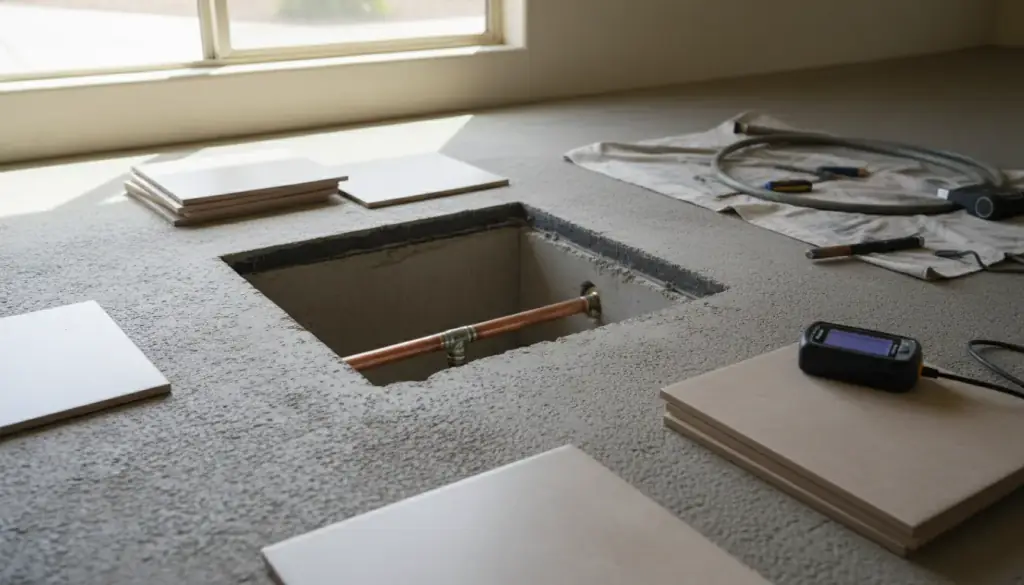
A lot of Arizona homes sit on a concrete slab, and some of the water lines run through or under that concrete instead of through walls and an attic. When one of those lines starts to leak, nothing drips from a ceiling and nothing shows up under a sink. The water just goes into the ground under your house. That's why slab leaks tend to be found by a bill or a sound before anyone sees water. Here's what to watch for, what to do the moment you suspect one, and how a plumber finds the exact spot without tearing the floor apart.
What a slab leak actually is
A slab leak is a leak in a pressurized water line that runs in or beneath the foundation slab. It can be a hot line or a cold line. Pipes in that spot can wear from the outside where they rub against concrete, rock or other lines, they can corrode, and they can take stress when the soil under a house shifts. A pinhole is all it takes. Pressure keeps pushing water out of it twenty-four hours a day.
The signs worth taking seriously
No single sign proves a slab leak, but several together make a strong case. These are the ones plumbers hear about most:
- A water bill that climbs with no change in how you live.
- The sound of running or hissing water when every fixture and appliance is off.
- A warm spot on a tile or concrete floor, which can mean a hot water line is leaking underneath.
- Water stains, a musty smell, or damp carpet and baseboards along an interior wall.
- Flooring that bubbles, lifts or cracks for no clear reason.
- Low water pressure that has no other explanation.
- A water meter that keeps moving after you've shut everything off in the house.
Sunstate Plumbing's list of reasons to call a plumber includes higher bills, water stains and persistent leaks, and all three show up on this list for a reason.
What to do first
Find your main water shutoff and close it. Learn where it is before you need it, because during a leak is a bad time to start looking. With the main closed, the water stops feeding the leak, and the damage stops growing. If the meter dial no longer spins with everything off and the main closed, you've confirmed the leak is on your side of the meter.
Then move anything valuable off wet floors, take photos of whatever damage you can see, and call a plumber. Leave the hammer and chisel alone. Cutting into a slab without knowing where the line is risks hitting other pipes, electrical conduit or the slab's reinforcement, and you'll still have the original leak.
How leaks are located before anything is opened
Good leak detection is about pinpointing, not guessing. A plumber starts by isolating the problem: shutting off sections of the system to see which line is losing pressure. Then the real location work begins, and the usual tools include electronic listening equipment that picks up the sound of escaping water through the concrete, moisture meters, and thermal tools that can show a warm line where a hot water pipe is leaking.
The goal is to open the smallest possible section of floor, in the right place, once. Leak Detection and Repair is its own service at Sunstate for exactly this reason: finding the leak accurately is half the job, and a repair crew working from a precise location does far less damage than one working from a rough idea.
Repair options once the leak is found
There are two broad paths, and the right one depends on the condition of the pipe. If the line is sound apart from one failure point, a technician can open the slab at that spot and repair the line. If the pipe is failing in several places, repairing one pinhole only moves the problem, and rerouting the line through walls or an attic can make more sense. That's a repiping job. Neither is automatically better. Ask for the reasoning, and ask what the plumber saw on the pipe when the area was opened.
Sunstate explains the options up front, with upfront pricing and no surprise costs or hidden fees once the work starts. If the repair comes in over $250, the current special of $25 off any repair over $250 may apply through December 31, 2026. Restrictions apply, and it can't be combined with other offers.
Why waiting costs more
A slab leak doesn't stop on its own. Water that escapes under the house can soften the ground under the slab, ruin flooring and drywall, and set up mold. Meanwhile you're paying for every gallon that disappears. The earlier you shut off the water and call, the smaller the repair tends to be.
If you suspect a leak under your floor, call Sunstate Plumbing at (623) 937-4258. Emergency service is available 24/7, and the Leak Detection and Repair page explains how the process works from the first call to the finished repair.
Sunstate Plumbing, Inc, (623) 937-4258
Call (623) 937-4258More articles
How Hard Water Wears Out a Water Heater in the West Valley
Our water leaves minerals on every faucet, and the water heater is where most of them end up.
Tank, Tankless or Heat Pump: Choosing a Water Heater for an Arizona Garage
The best water heater for your house depends on your garage, your fuel and how many people share the hot water.