How Hard Water Wears Out a Water Heater in the West Valley
Our water leaves minerals on every faucet, and the water heater is where most of them end up.
October 16, 2026 · 4 min read
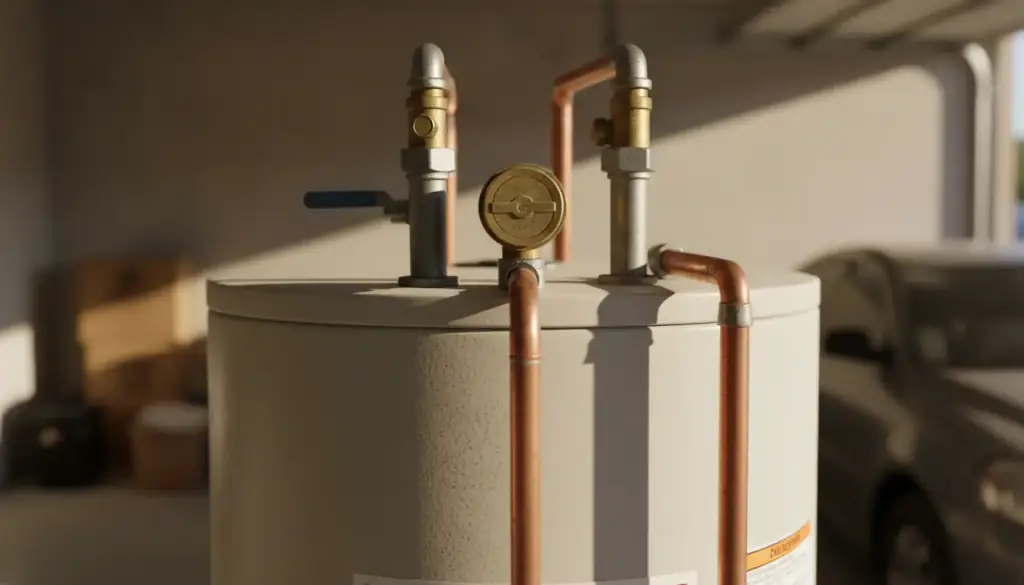
If you live in Peoria, Glendale, Surprise or anywhere else in the West Valley, you already know what our water leaves behind. White crust on the shower head. Spots on the glass that never quite wipe clean. A kettle that scales up within weeks. That same mineral load goes into your water heater every day, and the heater is the one appliance in the house that heats the water and then holds it still while the minerals settle out. Here's what actually happens inside the tank, and what a little yearly attention does about it.
What hard water does inside the tank
Hard water carries dissolved calcium and magnesium. Heat pushes those minerals out of the water. Inside a tank water heater they show up as scale on the heating elements and as loose sediment that settles into a layer on the floor of the tank. Sunstate Plumbing's own water heater pages point out that Glendale's water is very hard, and the rest of the West Valley is in the same boat.
None of this happens overnight. A new tank can run quietly for years. But the layer grows a little every time the heater cycles, and it never leaves on its own. By the time you notice a symptom, the tank has usually been working around the buildup for a long while.
Sediment: the noise, the slow recovery and the higher bills
Sediment is the first problem most homeowners hear about, quite literally. In a real house it tends to look like this:
- Popping or rumbling when the heater runs, caused by water trapped under the sediment and boiling up through it.
- Hot water that runs out sooner than it used to, because sediment takes up room in the tank that hot water should occupy.
- Long heating times. In a gas heater the burner has to heat through a layer of minerals first, and in an electric heater scale insulates the elements from the water.
- A heating element that burns out early, since a scaled element runs hotter than a clean one.
- A higher gas or electric bill for the same amount of hot water.
These are also the symptoms of a tank that's too small or an element that has failed, which is why it pays to have a plumber look before anyone talks about replacing the heater. Sometimes a flush and a new element keeps a perfectly good tank going for years.
The anode rod is the part that's meant to wear out
Every tank water heater is a steel tank with a glass lining, and no lining is perfect. The anode rod hangs inside the tank as a sacrificial piece of metal, usually magnesium or aluminum. Corrosion goes after the rod first so that it doesn't go after the tank. Once the rod is eaten away, the tank wall is next.
You can't see the rod from outside, so most people never think about it until something shows up: rusty or discolored hot water, a sulfur or rotten egg smell, or a leak at the bottom of the tank. Checking the rod during a yearly visit costs far less than replacing a tank, and swapping a worn rod is a small job while the tank itself is still sound. Once the tank wall has corroded through and started to leak, though, no new rod will save it.
Why flushing once a year makes sense
Flushing means draining water from the bottom of the tank through the drain valve so the sediment leaves with it. Done every year, the layer stays thin and mostly loose. Skip it for five or six years in hard water and that sediment can pack down like wet cement, and the drain valve itself can clog. That's the story behind a lot of do-it-yourself flushes that end with a trickle and a homeowner giving up.
When a technician does it, the power or gas gets handled first, the tank is flushed until the water runs clear, and then the rest of the heater gets a look. That means the anode rod, the temperature and pressure relief valve, and the connections where small leaks begin. That last check is where little problems get caught before they turn into a flooded garage. Not every old heater is a good candidate for a flush, and a good tech will tell you plainly when a tank is too far gone to benefit.
Where a water softener fits in
Flushing deals with what's already in the tank. A water softener deals with the minerals before they get there. Sunstate installs softeners, along with reverse osmosis and whole-house filtration, and makes sure the system is sized, calibrated and maintained for the home. A softener costs more up front than a flush, but it also cuts the scale on fixtures, dishes and laundry and eases the load on every water-using appliance in the house, not just the heater.
What a yearly tune-up looks like
Sunstate Plumbing offers a standard water heater tune-up for $189, valid through December 31, 2026. Restrictions apply, and the offer can't be combined with any other offer, so ask what fits your situation when you call. The visit is the flush, the anode rod check and a look over the safety parts, all in one trip.
If your heater is popping, running out of hot water early or sending out rusty water, call Sunstate Plumbing at (623) 937-4258. The Water Heater Repair page lists what the technicians check on tank and tankless units, and a real person answers the phone around the clock when hot water becomes an emergency.
Sunstate Plumbing, Inc, (623) 937-4258
Call (623) 937-4258More articles
Slab Leaks in Arizona Homes: Signs, First Steps and How They're Found
A leak under the concrete won't leave a ceiling stain, so you have to know the other signs.
Tank, Tankless or Heat Pump: Choosing a Water Heater for an Arizona Garage
The best water heater for your house depends on your garage, your fuel and how many people share the hot water.