Tank, Tankless or Heat Pump: Choosing a Water Heater for an Arizona Garage
The best water heater for your house depends on your garage, your fuel and how many people share the hot water.
October 16, 2026 · 4 min read
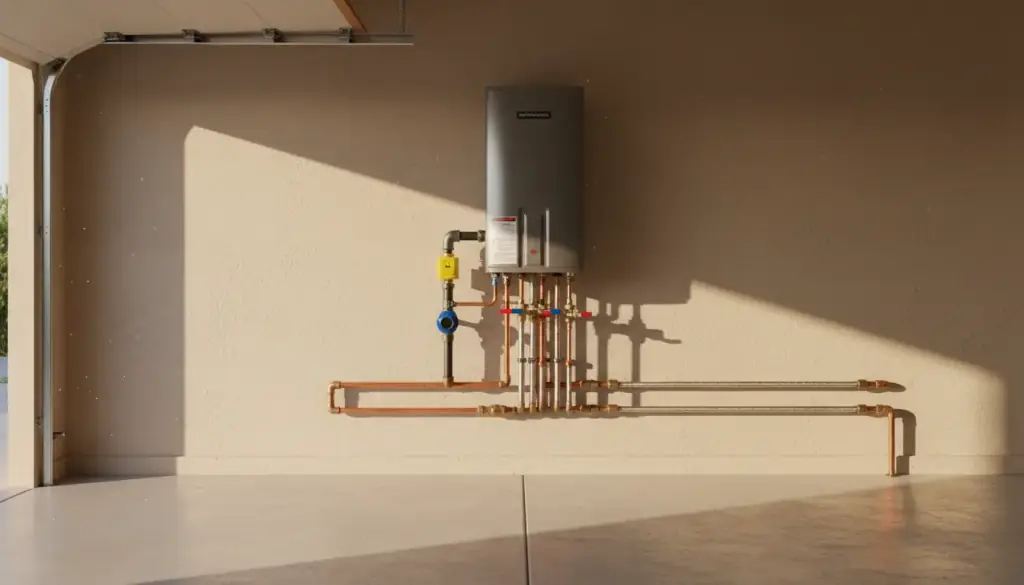
In most Arizona homes the water heater lives in the garage, a laundry nook or a closet on the outside wall, and it has to survive summer heat that would bother most appliances. When the old heater finally gives out, you've got three types to choose from and two fuels. Sunstate Plumbing installs tank, tankless and hybrid heat pump models, so here's an honest comparison of how they fit an Arizona home.
The traditional tank heater
A tank heater keeps a set volume of water hot all day and refills it as you use it. It's the simplest design, it's the easiest to swap for an identical model, and it usually costs the least to buy and install. The downside is that it keeps heating water you aren't using, and once the tank runs out, you wait for it to recover. For a household where several showers and a load of laundry stack up in the same morning, tank size matters. An undersized tank is one of the common causes of hot water running out early.
Tankless: hot water on demand
A tankless unit heats water as it flows, so there's no tank to run out of. Wall-mounted units free up floor space in the garage, and they don't waste energy keeping a tank hot overnight. They do come with conditions. A gas tankless unit needs proper venting and a gas line that's sized to feed it, and an electric tankless unit pulls a lot of power, which may call for an upgraded circuit or even panel capacity. Arizona's hard water also scales up the heat exchanger inside, so tankless units need periodic flushing just as tanks do. Our summers help, since incoming water is warmer and the unit has less work to do, but winter mornings are a different story.
Hybrid heat pump: the one that suits a hot garage
A hybrid, or heat pump, water heater doesn't make heat so much as move it. It pulls warmth out of the air around it and puts it into the water, which uses much less electricity than a standard electric element. In a hot garage that's an advantage, because there's plenty of heat to draw from, and the unit cools and dries the space a little as a side effect.
The trade-offs are practical ones. A heat pump unit is taller than a standard tank and needs open space around it for airflow. It needs a condensate drain, and it needs a 240-volt electrical circuit. It also costs more to buy. Most models can switch to a standard electric mode when you need extra recovery, which helps on busy mornings, but it's a different appliance from a basic tank, and it should be placed with that in mind.
Gas or electric
Gas heaters recover quickly and keep working during a power outage, as long as the model doesn't rely on electricity for its controls. They need a gas line, a flue or vent, and a combustion air supply. Electric heaters are simpler to install in many spots because there's no combustion, no flue and no gas line to maintain, but they need a dedicated 240-volt circuit and they recover more slowly. Your utility rates, whether your home already has gas service and how long you plan to stay all matter more than any general rule. A plumber who sees your garage can tell you which one it is in about ten minutes.
What a gas-to-electric changeover involves
Plenty of homeowners switch fuels when a gas heater dies, especially when the gas line is awkward or they'd rather not deal with venting. It's more than swapping one unit for another. A changeover typically means:
- Shutting off the gas supply to the heater and capping the line safely.
- Dealing with the old vent or flue so it isn't left as an open path in the garage ceiling or wall.
- Running a dedicated 240-volt circuit to the new heater, with the right breaker and wire size, and checking that the panel has room for it.
- Installing the new unit with a proper pan, a drain and a temperature and pressure relief valve piped to a safe discharge point.
- Pulling a permit and arranging an inspection where your city may require one.
Arizona code calls for proper venting and a working T&P valve on the heaters that need them, so the work on the gas side matters even when it's coming out. Ask up front who handles the electrical portion, what the new circuit will require and whether any panel work is expected. Then you won't be surprised halfway through.
Questions that settle the decision
Start with how many people use hot water at the same time. Then look at the garage: how much space is there, how hot does it get, and is there an existing gas line? Finally, think about how long you'll stay in the house. A heat pump model pays you back over the years, and that makes the most sense for a home you're keeping. If you're selling soon, a good standard tank may be the sound choice.
Sunstate currently offers $200 OFF new water heater installation through December 31, 2026. Restrictions apply, and it can't be combined with any other offer. Financing is available through GreenSky, and you can check your eligibility without any impact to your credit.
To talk through your garage and your options, call Sunstate Plumbing at (623) 937-4258. The Water Heater Installation and Replacement page covers tank, tankless and hybrid models, and same-day scheduling is often available when a heater fails.
Sunstate Plumbing, Inc, (623) 937-4258
Call (623) 937-4258More articles
How Hard Water Wears Out a Water Heater in the West Valley
Our water leaves minerals on every faucet, and the water heater is where most of them end up.
Slab Leaks in Arizona Homes: Signs, First Steps and How They're Found
A leak under the concrete won't leave a ceiling stain, so you have to know the other signs.