Backflow Testing for West Valley Businesses: What the Tester Actually Does
A backflow preventer is the one device on your main water line that quietly protects everyone else's drinking water.
October 16, 2026 · 4 min read
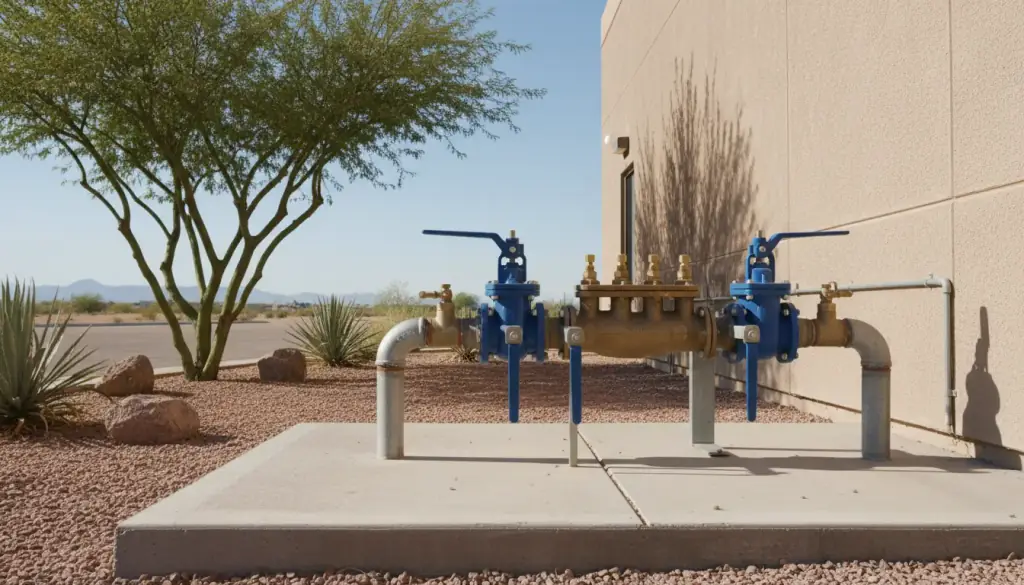
If you run a restaurant, a retail center, an office building or a manufacturing facility in the West Valley, there's a good chance a backflow prevention device sits on your main water connection or on a line that feeds irrigation or fire protection. It isn't glamorous, it rarely gets noticed, and the day it matters is the day you wish someone had tested it. Here's what the device does, why testing is part of owning one, and what the person doing the test actually does on your property.
What backflow is, and what a preventer does
Water in the public supply normally flows one way: from the city's main into your building. Backflow is water moving the other direction, pulled or pushed backward when pressure drops in the main, or when pressure on your side rises above the city's. If that happens, whatever is in your plumbing can travel back toward the public water supply. That includes chemicals in a boiler loop, fertilizer on an irrigation line or the water in a dishwashing station.
A backflow prevention assembly is built to stop that. It uses check valves, which are spring-loaded one-way gates, and in some designs a relief valve that opens and discharges water if something goes wrong. It's a mechanical device with moving parts and rubber seals, and mechanical things wear.
Why testing is a recurring job
Commercial properties may be required by law to have a backflow prevention device on their main water connection to protect the public water supply from contamination. Arizona state law may require annual testing of backflow prevention assemblies by a certified tester, and Glendale's City Water Services may require that test results be submitted to the city on a regular basis.
Notice the word may. Requirements depend on the type of property, the type of assembly and the water provider that serves you, so the right first step is to ask your city's water department what applies to your address. A West Valley business in Peoria, Surprise or Avondale can have different paperwork from one in Glendale. A certified tester who works in the area regularly will know what each provider wants to see, and what format they want it in.
What a certified tester does on site
A test isn't a glance at the device. A certified tester connects calibrated test gauges to the assembly's test ports and checks, one component at a time, whether each check valve holds back pressure and whether the relief valve opens when it should. The device is temporarily taken out of normal service during the test, so a good tester will tell you ahead of time when your water may be interrupted, and schedule around your hours when they can.
The results go on a test report. A passing assembly gets documented and, where your water provider requires it, the report gets submitted. A failing assembly means the next step is diagnosis.
If the device fails
Failure is common enough that it shouldn't alarm you. Typical causes are worn rubber seats or discs, a fouled check valve that's holding debris, a weak spring or a relief valve that's leaking. In many cases the fix is replacing the worn internal parts, not the whole assembly. Once the repair is done, the assembly must be tested again, and the new passing result is what gets documented.
That's the full cycle Sunstate Plumbing handles: inspection, diagnosis, repair if the device fails, and re-test support to help restore compliance without prolonged disruption to your operations. As a certified backflow tester, Sunstate can serve as a single point of contact year after year, which beats juggling one company for the test and another for the repair.
How to make test day easier
- Know where each assembly is, and keep the area around it clear. A device that's buried in landscaping or blocked by stored boxes is hard to test.
- Keep your last test report. It shows the date and the result, and it's usually the first thing an inspector asks for.
- Put the annual date on a calendar rather than waiting for a notice from the city.
- Mention any recent changes to the building, like a new irrigation zone, a tenant improvement or a new kitchen, since those can change what your property needs.
- Tell the tester when a shutdown would hurt, such as the middle of a lunch rush or just before a health inspection.
Why local matters for a commercial account
Sunstate Plumbing is a family-owned, locally operated plumber that knows local codes and has working familiarity with Glendale inspectors, which can help keep commercial projects moving through permitting without unnecessary delays. It also answers its own phones, with no answering service, no voicemail routing and no callback queue, and emergency commercial service is available 24/7. For a business, that matters most when a failed backflow device or a broken line threatens operations at 2 a.m.
To set up testing or get a failed assembly repaired, call Sunstate Plumbing at (623) 937-4258 and ask for commercial plumbing. The Commercial Plumbing page covers backflow prevention inspections, repair, maintenance and re-testing, and you can ask about warranties when you call.
Sunstate Plumbing, Inc, (623) 937-4258
Call (623) 937-4258More articles
How Hard Water Wears Out a Water Heater in the West Valley
Our water leaves minerals on every faucet, and the water heater is where most of them end up.
Slab Leaks in Arizona Homes: Signs, First Steps and How They're Found
A leak under the concrete won't leave a ceiling stain, so you have to know the other signs.